噪点 · 信号的地板Noise · The signal floor
学习目标LEARNING OBJECTIVES
学完你能说清噪点从哪来、ISO 到底在放大什么,以及拍摄和后期各该怎么让画面离地板远一点。
概念说明CONCEPTS
操作步骤STEPS
- 拍摄端:不过曝的前提下向右曝光,别指望后期救暗部
- 后期端:降噪(NR)放节点树最前面——先清地板,再谈调色
- 时域降噪管运动画面,空域降噪管静止细节,先用时域
- 锐化永远放最后:锐化会把噪点一起锐化
练习PRACTICE
动手任务
找一条欠曝素材,先把暗部拉亮看彩噪炸出来;再上时域降噪对比;最后故意先锐化再降噪,看顺序的代价。
自检清单
做完任务后逐条自查,全部能打勾才算过。
常见问题FAQ
降噪能把噪点去干净吗?
不能。降噪是权衡:抹掉噪点的同时也在抹细节。地板能压低一点,但没拍到的信息救不回来。
胶片颗粒和数码噪点是一回事吗?
不是。胶片颗粒是成像介质本身的纹理,数码噪点是信号不足的缺陷。一个加分一个减分,别混为一谈。
Learning Objectives学习目标
After this card you can say where noise comes from, what ISO actually amplifies, and how to keep your picture away from the floor — on set and in post.
Concepts概念说明
Noise is the floor of the signal: in low light the photons themselves arrive unevenly (shot noise), and the sensor circuitry adds its own error on top (read noise). Two layers become the dirty grain you see.
- ISO is an amplifier, not a lamp — higher ISO creates no light; it amplifies the signal you have, noise included
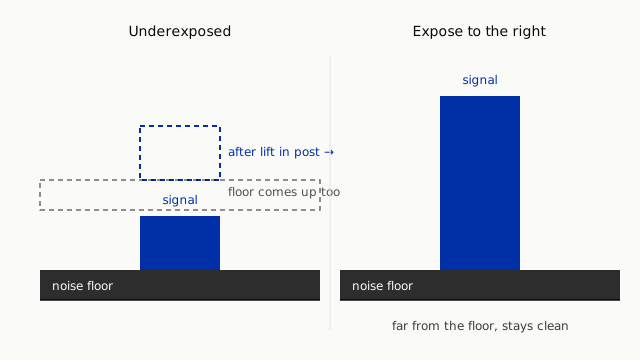
- Underexposure is a noise amplifier — shadows already sit near the floor; lift them in post and the whole floor comes up
- Chroma noise looks worse than luma noise — the coloured speckles in shadows stand out because the channels' noise is uncorrelated
- Expose to the right (ETTR) — give the sensor more light short of clipping; the further the signal stands from the floor, the cleaner the image
See also: Dynamic range · Bit depth · Log
Steps操作步骤
- On set: expose to the right short of clipping — do not count on post to save the shadows
- In post: noise reduction (NR) goes first in the node tree — clean the floor before grading
- Temporal NR for moving images, spatial NR for static detail; start with temporal
- Sharpening always comes last — it sharpens the noise too
Practice练习
Hands-on task
Take an underexposed clip: lift the shadows and watch the chroma noise bloom; compare with temporal NR applied; finally sharpen before denoising on purpose and see what the wrong order costs.
Self-check
Work through the task, then tick every line; all checked means you own this card.
FAQ常见问题
Can NR remove noise completely?
No. NR is a trade: wiping noise wipes detail with it. The floor can be pushed down a little, but information never captured cannot be recovered.
Is film grain the same as digital noise?
No. Grain is the texture of the medium itself; digital noise is a defect of insufficient signal. One adds character, the other subtracts quality — do not confuse them.
本卡术语Terms in this card
降噪Noise Reduction Lift(暗部)Lift 调色Grade 合成Compositing 节点Node 位深Bit Depth 动态范围Dynamic Range